Discover the key insights from the Organic Cotton Summit in Istanbul, Türkiye
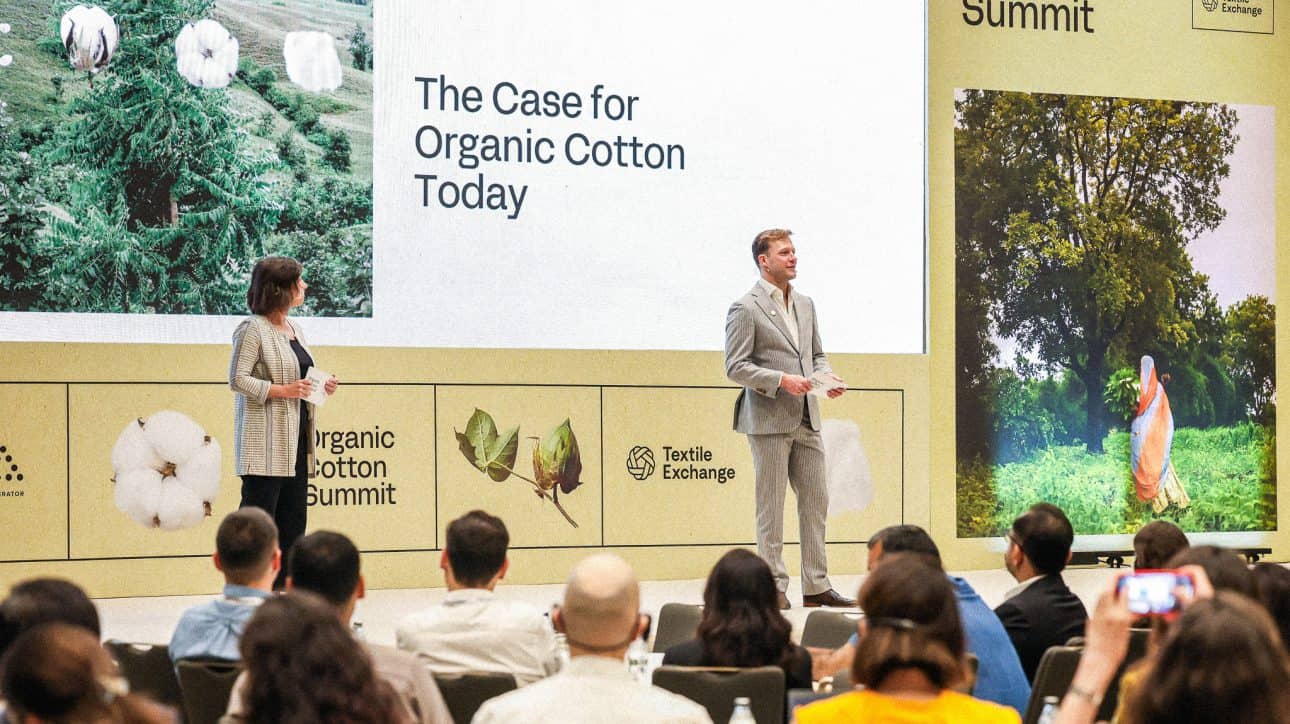
Hosted by the Organic Cotton Accelerator and Textile Exchange, the Organic Cotton Summit brought voices from across the organic cotton ecosystem and beyond to Istanbul from June 2–4, 2026.
Growing cotton organically supports healthier soils, reduces reliance on external inputs, and helps build stronger resilience to climate stress. These outcomes matter for farmers’ livelihoods and for the long-term health of land and communities.
At the same time, organic agriculture is a proven solution that aligns with the fashion, textile, and apparel industry’s expectations for preferred production systems, with the potential to meet growing needs for verification, compliance, and traceability.
Bringing a broad cross-section of the global organic cotton community together, the Organic Cotton Summit gave participants the opportunity to share their lived experience and practical insights, showing the industry’s continued commitment to collaboration, resilience, and collective action in this area. Here are some of the key takeaways from the event.
Key takeaways
Day 1
Day one’s conversations brought together perspectives from across the organic cotton supply system, from farmers and brands to producers and policymakers.
Long-term commitments are needed to scale organic cotton
Multiple sessions returned to the same challenge: farmers cannot transition to, or remain in, organic cotton systems without reliable demand. Speakers stressed the importance of long-term sourcing commitments, fair pricing, and stronger partnerships between brands and producers, making it clear that scaling organic cotton requires relationships that extend beyond individual projects or purchasing cycles.
Farmers need support beyond the farm gate
Farmers from Brazil, India, Pakistan, and Türkiye shared their experiences of the reality of organic production, discussing certification requirements as well as climate risks and market uncertainty. Their conversations highlighted the need for better access to technical assistance, certification support, and market opportunities. They concluded that stronger coordination across the entire value chain will be crucial if the industry is to achieve its goals for scaling organic cotton.
Traceability is becoming a core part of organic cotton systems
Beyond just a compliance requirement, traceability was discussed as a tool for strengthening transparency, accountability, and connection across the supply chain. Through insightful talks and workshops, the event looked at how digital systems, certification frameworks, and supply chain data can help support credibility and create greater visibility from farm to finished product.
Better funding and better data can unlock progress
Sessions on investment, climate action, and impact measurement explored how financial support and credible data can help accelerate organic cotton production. While challenges around cost and complexity remain, there is growing evidence that investment in organic systems can deliver measurable environmental benefits and support long-term resilience.
“Through organic agriculture, we contribute to soil restoration, climate change mitigation and adaptation, sustainable natural resource management, and the development of resilient rural communities.”
Boimamat Uzakov
Chief of the Board
NCC Bio-Kishovarz


“I’m the fifth generation of cotton growers. It’s an immense pride to represent my ancestors and my family but also all the community that works with cotton. Cotton helps us bring back dignity and income, and we learn with nature to live with adversity.”
Suzana Aguiar
Farmer and Representative
Borborema Agroecology Network

Key takeaways
Day 2
Day two focused on regional perspectives and the conditions needed in practice for organic cotton systems to thrive long term.
Regional realities must shape global strategies
Organic cotton systems operate in very different contexts around the world. We heard from those on the ground how local policy environments, infrastructure, market conditions, and production challenges shape opportunities for growth in each region. A message that kept getting repeated throughout the day was that solutions need to be adapted to regional realities rather than replicated from elsewhere.
Many regions are facing the same challenges
Despite certain regional differences, it became clear during the discussions that farmers and producer groups in different regions face similar issues. They pointed to rising certification costs, pressure on farm economics, limited access to seed and inputs, and uncertainty around future demand. Uncovering these shared challenges created opportunities for cross-regional learning and collaboration.
The cost of transition cannot fall on farmers alone
In the sessions, participants discussed how the costs associated with certification, training, and implementing organic practices are often concentrated at farm level. There was a general recognition that brands, retailers, and other supply chain actors have an important role to play in supporting the transition and sharing investment more evenly.
Farmer voices need to remain at the center of decision-making
The regional dialogues sessions reinforced the value of bringing the knowledge and perspectives of farmers directly into industry conversations. Discussions were grounded in farmers’ practical experience, helping develop understanding of organic cotton production and build alignment on priority actions and commitments needed to strengthen both local systems and the global case for organic cotton.
“Organic cotton has enormous potential, but potential does not scale on its own. It scales through trust, collaboration, long-term commitment, and shared responsibility across the value chain. That work belongs to all of us in the room.”
Ashley Gill
Chief Standards and Strategy Officer
Textile Exchange


Experiencing organic cotton production on the ground
Following the summit, 50 participants traded the conference room for picturesque Aegean region of Aydın, Türkiye, to get a closer look at organic cotton farming in practice.
Attendees were able to visit a certified organic cotton farm during early growing season, walking through the cotton fields and seeing how organic and regenerative practices are applied on the ground, giving them insight into the local production context. They also visited a local ginning facility, where seed cotton is separated to become fiber, and met a local farmer to discuss what it takes to make organic cotton farming viable in the long term.
The trip offered the opportunity to gain practical insights into organic cotton farming and its positive impact on soil health, biodiversity, and farmer resilience, as well as how sourcing decisions connect with on-the-ground outcomes.

Related Posts