
LIFE CYCLE ASSESSMENT
Our Life Cycle Assessment (LCA) studies
Textile Exchange is leading a series of seven Life Cycle Assessment (LCA) studies designed to improve the quality and robustness of environmental impact data for raw material production across the fashion, textile, and apparel industry.
By addressing critical data gaps and methodology variability for priority fibers, the studies provide credible, fully documented data that supports more accurate modeling and tracking of greenhouse gas emissions.
LCA STUDIES
The raw materials and fibers covered
All Textile Exchange LCA studies cover the production stages of raw materials and fibers from cradle to gate.
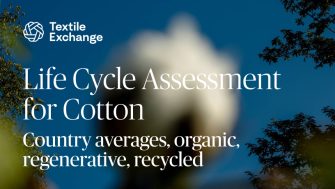
The first LCA on cotton was published in March 2026. Throughout 2026 and 2027, we will publish further LCA studies on polyester, cashmere, nylon, leather hide, wool produced to Textile Exchange’s Responsible Wool Standard, and mohair produced to Textile Exchange’s Responsible Mohair Standard.
These priority raw materials and fibers were selected based on:
- Total industry volume
- The current availability of impact data
- The quality of existing datasets
This was to ensure that the research focuses on where it can deliver the greatest value and industry-wide impact.

LCA+
Learn more about our LCA+ approach
All of the studies take a holistic “LCA+” approach, looking at indicators beyond those covered in traditional LCA methodology to give organizations insights into other impact areas, such as:
- Biodiversity
- Soil health
- Animal welfare
- Social impacts
Watch the video to hear Textile Exchange’s Chief Impact Officer, Beth Jensen, explain more about the LCA+ approach.

PUBLISHED
Studies and guidance published so far

GLOBAL DATABASES
Integrating the data into global databases
Once published, all Textile Exchange LCA data will be submitted to global industry databases to support more accurate modeling and progress tracking of greenhouse gas emissions and other impacts.
The data is primarily intended to serve as proxy data, in cases where source-specific LCA data is not available. It is designed to provide a credible, consistent foundation for understanding the impacts of cotton production and to inform data-driven decision-making.
The database platforms include:

Read our guidance on responsible use of LCA data
As with all LCA data, the findings from Textile Exchange’s LCA studies should be used carefully and in the appropriate context. Results from LCA studies are sensitive to methodological choices, assumptions, and boundaries. The same dataset can also produce different results when applied within different methods. For these reasons, comparisons should not be made between studies or between datasets within individual studies, such as production systems or regions.
Ensuring Integrity in the Use of Life Cycle Assessment Data
A comprehensive position paper outlining best practice for the use of LCA data. It provides guidance on how data should be used, and—equally importantly—how it should not be used. It is intended for anyone looking to develop a greater understanding of the use of LCA studies and LCA data in the textile industry—particularly for brands using LCA data directly or those who rely on it for their impact modeling or progress tracking.
Textile Exchange’s LCA Model Comparison—Cotton Case Study
An analysis of how different methods can produce varying results from the same dataset.